Trim Height Inspection
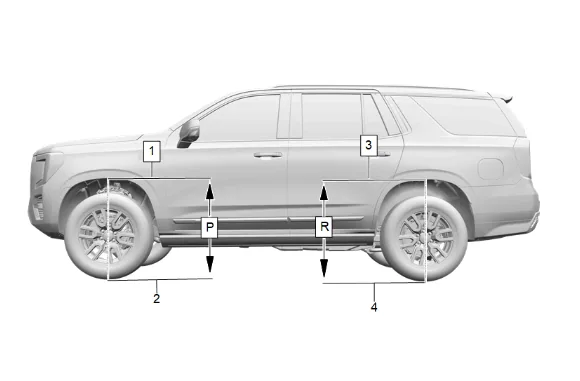
Measurement Definitions P Height: The vertical distance from the ground to the top of the wheel opening (1) through the center line of the front wheel (2). R Height: The vertical distance from the ground to the top of the wheel opening (3) through the center line of the rear wheel (4). Use the following procedures to measure the P and R dimensions:
- Push the front bumper down a minimum of 25 mm (1 in), and release. Perform this step three times.
- Measure and record the trim height per the “Measurement Definitions” above.
- Lift the bumper up a minimum of 25 mm (1 in), and release. Perform this step three times.
- Measure and record the trim height per the “Measurement Definitions” above.
- The true P height measurement is the average of the measurements taken in step 2 and 4. Trim Height Specifications
- Repeat the above steps at the rear of the vehicle for the R heights.
- See the trim height specifications for the modified R height measurement. Trim Height Specifications
- If the P and R heights are outside of the specifications, measure the Z and D heights. Z Height Measurement The Z height dimension measurement determines the proper ride height for the front end of the vehicle. No adjustments are possible and could require replacement of suspension components.
- Jounce the front suspension of the vehicle by pushing the vehicle down and lifting up.
- Allow the vehicle to settle and take a measurement.
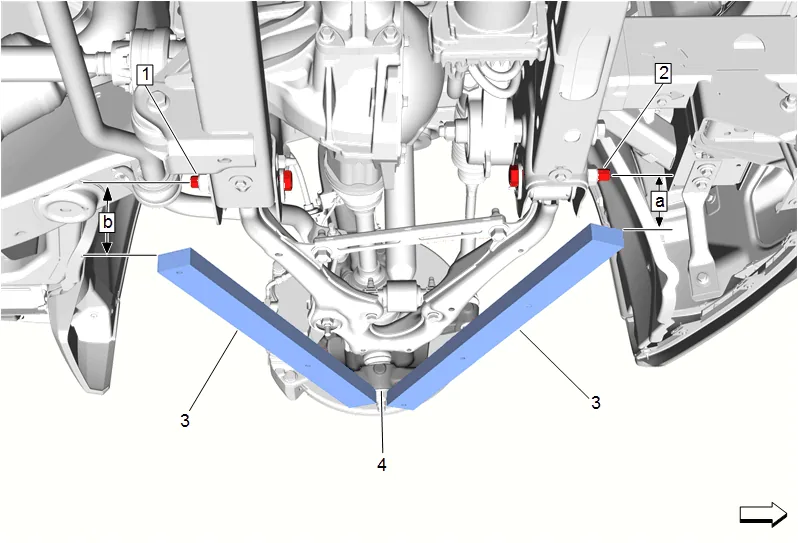
- Set the top edge of the level (3) on the reference surface of the steering knuckle (4) and extend the level (3) directly under the front end of the front lower control arm adjust bolt (2).
- While keeping the level (3) in contact with the reference surface of the steering knuckle (4), adjust the level (3) up/down until the bubble indicates it is horizontally level.
- Measure the distance (a) between the center of the front lower control arm adjust bolt (2) and the top of the level (3) for your first measurement
- Keep the top edge of the level (3) on the reference surface of the steering knuckle (4) and move the level (3) directly under the rear end of the front lower control arm adjust bolt (1).
- Measure the distance (b) between the center of the front lower control arm adjust bolt (1) and the top of the level (3) for your second measurement.
- Average the measurements (a) and (b) and record the results.
- Repeat steps 4 through 9 for the opposite side.
- Compare the results with specifications. Trim Height Specifications Z Height Adjustment For coil spring suspension or air suspension vehicles: Replace worn or damaged components as necessary. D Height Measurement The D height dimension measurement determines the proper ride height of the rear end of the vehicle.
- Jounce the rear suspension of the vehicle by pushing the vehicle down and lifting up.
- Allow the vehicle to settle and take a measurement.
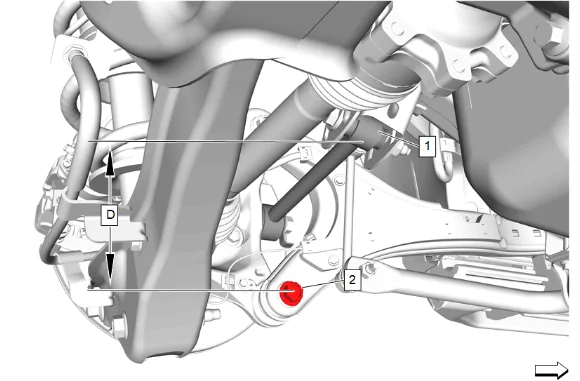
- Measure the D height dimension from the bottom surface of the inner adjust link bushing at the frame (1) to the center of the lower trailing arm to knuckle bolt (2).
- Compare the recorded readings with specifications. Trim Height Specifications
- If any of these measurements are out of specifications, inspect for the following conditions: Worn or damaged suspension components Collision damage